
Aparna Rollform

Cable Tray Junction Box: Uses, Types and How to Select One

cable tray junction box

A cable tray junction box is a metal enclosure fitted on a cable tray or raceway run to give protected access to cables at a fixed point — where cables are pulled through, branched to a service, joined or terminated. In Indian projects, the term most often refers to the GI junction box used on raceway (trunking) runs, especially underfloor raceways.

What Is a Cable Tray Junction Box?

A cable tray or raceway carries cables along a route. A junction box is a point on that route where the cables can be reached. It encloses the cables at that point, protects any joints or connections from dust and physical damage, and has a removable cover for access during installation and maintenance.

The two components do different jobs within a cable management system. The tray or raceway supports and routes the cables; the junction box provides an enclosed access point along that route.

Two Ways the Term Is Used

Suppliers and specifiers use “cable tray junction box” to mean two different things:

UsageWhat it refers toTypical setting
Raceway junction boxA GI box built into a raceway (trunking) run. It joins raceway lengths and provides access, cable-pulling and service take-off points.Underfloor and surface raceway systems in offices, IT facilities and commercial buildings. This is the common usage among Indian cable tray manufacturers.
Tray-mounted enclosureAn electrical enclosure fixed on, beside or at the end of an open cable tray, where cables are terminated, spliced or transferred to equipment or conduit.Industrial plants, instrumentation and process facilities.

Both are enclosures. The difference is the containment they serve — an enclosed raceway in the first case, an open cable tray in the second. Check which one a drawing or bill of quantities means before pricing it.

Junction Box vs Cable Tray Fittings

Junction boxes are sometimes confused with tray fittings such as tees, crosses and bends, because both sit where a cable route branches or turns. They are different components.

ComponentWhat it doesEnclosed?
Tee or crossBranches the tray route in two or three directionsNo — open, unless a cable tray cover is fitted
BendChanges the direction or level of the trayNo
ReducerChanges the tray widthNo
Junction boxProvides an enclosed access point for pulling, branching, joining or terminating cablesYes — with a removable cover

On an open tray, a route can branch through a tee or cross without a box. A junction box is used where the cables need to be enclosed at that point — on a concealed raceway run, or where cables are joined or terminated.

What a Junction Box Does in a Cable Management System?

  • Access on concealed runs. An underfloor raceway is buried under screed and flooring. After the floor is finished, junction boxes are the only points where the cables can be reached.
  • Cable pulling points. Long runs and changes of direction make cable pulling harder. A box gives an intermediate point to pull from.
  • Service take-off. Cables leave the main run at a box to feed a floor outlet, a workstation or a piece of equipment.
  • Protection for joints and terminations. Where cables are joined or connected to terminals, the box shields the connection from dust, moisture and accidental contact.
  • Separation of services. Multi-compartment boxes keep power and data cables apart through the junction, matching the compartments of the raceway.

Types of Cable Tray Junction Boxes

Junction boxes are usually described by where they are installed:

TypeWhere it is installedWhat decides the design
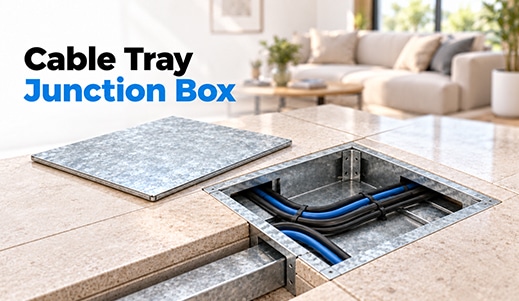
Underfloor junction boxCast into the floor screed on an underfloor raceway, with the cover at finished floor levelFloor build-up depth, and a cover that sits flush with the finished floor
Surface or ceiling junction boxOn raceway runs fixed to walls or ceilingsAccess after installation; screw-fixed or clip-on cover
Tray-mounted enclosureFixed to, beside or at the end of an open cable trayIngress protection (IP) rating and cable entry arrangement

Within each type, boxes vary by:

  • Shape: square or rectangular.
  • Compartments: single or multi-compartment, matched to the raceway. Crossover designs let one service pass over another without the cables mixing.
  • Material and finish: pre-galvanised (GI) steel, hot-dip galvanised steel, powder-coated steel, aluminium or stainless steel.

How to Select a Cable Tray Junction Box?

A junction box is chosen to suit the raceway or tray it connects to and the conditions at its location. Check these eight points:

FactorWhat to check
Size matchWidth, height and number of compartments suit the raceway or tray the box connects to.
Internal spaceRoom to pull cables and to respect the minimum bending radius of the largest cable passing through.
Depth (underfloor)Box height fits within the screed and finished-floor build-up. Agree it with the raceway supplier before the screed is poured. A welded box cannot be adjusted for height on site.
FinishSuited to the worst condition at the location. A box cast into the floor cannot be inspected or repaired once the floor is finished.
CoverFlush and screw-fixed for floors; screw-fixed or clip-on for surface and ceiling runs.
Cable entriesNumber, size and position of the entries or cut-outs, and whether cable glands are required.
Ingress protectionFor enclosures outside dry indoor areas, an IP rating to IEC 60529 that suits the dust and water exposure.
Earthing continuityThe metal box is bonded to the earthing system with the raceway or tray. Where coatings break metal-to-metal contact at joints, use suitable bonding arrangements.

Planning Junction Box Positions

On an underfloor raceway, junction box positions are a design decision. Once the screed is laid, a box cannot be added or moved without breaking the floor. Mark box positions on the layout drawing:

  • at every change of direction in the raceway run
  • at every service or outlet take-off
  • along long straight runs, where pulling cable over the full length would be difficult
  • wherever maintenance access will be needed later

There is no single fixed spacing for straight runs. It depends on the cable type, the number of bends and the project specification.

IMAGE WIDGET (place in this section, once the drawing is made)
Image: labelled section drawing, an underfloor raceway in the screed, with junction boxes at a change of direction and at a service take-off, and the finished floor level marked
File name: underfloor-raceway-junction-box-positions.webp
Alt text: Underfloor raceway with cable tray junction boxes at a change of direction and a service take-off

Junction Boxes from Aparna Rollform

Aparna Rollform manufactures junction boxes at its Patancheru plant as part of its GI raceway system, for underfloor and surface raceway runs. Each box is made to the project’s approved drawing, in 150 mm, 225 mm, 300 mm and 400 mm sizes with 1.6–2.0 mm base thickness and 50 mm or 70 mm height, in square or rectangular profiles. Multi-compartment boxes to match two- and three-compartment raceways can also be made to drawing.

The boxes are made from pre-galvanised (GI) steel. Hot-dip galvanising, carried out after fabrication, is available on request. Each box is a welded unit with a screw-fixed cover, and the raceway enters through cut-outs in the box wall. A welded box cannot be adjusted for height on site, so its height is fixed from the approved drawing before fabrication. Full raceway specifications, including widths of 50–300 mm with one to three compartments, are listed on the raceways page.

Frequently Asked Questions On Cable Tray Junction Box

Is a cable tray junction box the same as a tee or cross fitting?

No. A tee or cross is an open tray fitting that branches the cable route. A cable tray junction box is an enclosure with a removable cover that gives protected access to cables for pulling, branching, joining or terminating.

The box must match the raceway’s width, height and number of compartments, with enough internal space for cable pulling and bending radius. Aparna Rollform makes junction boxes to the project’s approved drawing, in 150 mm, 225 mm, 300 mm and 400 mm sizes with 50 mm or 70 mm height.

Pre-galvanised steel suits dry indoor conditions. A box cast into the floor cannot be inspected or repaired once the floor is finished, so where moisture or corrosive conditions are expected, specify a finish with higher corrosion resistance, such as hot-dip galvanised steel, and confirm it with the supplier at the design stage.

It depends on the electrical code and the project specification. The US National Electrical Code (Article 392) permits insulated cable splices inside a cable tray if they remain accessible. A project specification may instead require joints and terminations to be made inside an enclosure, so check it before planning joints on the tray.

Related Blogs