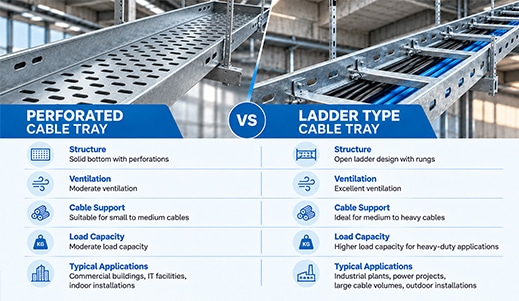
Cable Support: Continuous Base vs Rungs
This is the difference behind most of the others. On a perforated tray, the base supports the cable at every point. On a ladder tray, the cable spans from one rung to the next.
Large power cables are stiff enough to bridge that gap without trouble. Small cables are not. A thin control or data cable laid across rungs spaced a few hundred millimetres apart can sag between them. If a route carries mostly small cables, a perforated tray avoids the problem.
Ventilation and Heat Dissipation
Ladder trays give better airflow. Their base is almost entirely open, so heat from the cables escapes from above and below. Perforated trays also ventilate well through their slots, but part of the base is solid steel, so less air reaches the underside of the cables.
Airflow matters most for heavily loaded power cables, because a cable that runs hotter must be derated, meaning it can carry less current. For cable sizing, IEC 60364-5-52 lists cables on a perforated tray and cables on a ladder as separate installation types. The designer should use the factors for the tray type actually installed.
Some comparisons online rate perforated trays as better ventilated than ladder trays. For the same cables and layout, the more open ladder design allows more airflow.
Load Capacity and Support Span
Ladder trays are generally chosen for heavy cable loads and for longer spans between supports, because their deep side rails work like beams. This is where the common rule “ladder for heavy cables, perforated for light cables” comes from.
Treat that rule as a starting point, not a specification. The load any tray can safely carry depends on its side height, steel thickness and the distance between supports, whichever type it is. So don’t compare a deep perforated tray and a shallow ladder tray on type alone.
Before choosing, ask the manufacturer for the safe working load (SWL) at the support span shown on your drawings. IEC 61537 sets out the SWL test for both cable trays and cable ladders.
Cable Access, Exits and Future Changes
On a ladder tray, cables can drop out between any two rungs, and you can tie them directly to the rungs. This makes additions and re-routing simple. On a perforated tray, cables usually leave through a drop-out fitting or an opening cut in the base or side, with cable ties passing through the slots.
Both are open trays, so you can lay new cables in from above on either type without pulling them through.
Dust, Water and Protection
Dust and water fall straight through a ladder tray. On a perforated tray, the slots let water drain, but dust can settle on the solid parts of the base. This is worth considering in dusty areas.
In return, the continuous base of a perforated tray gives cables some protection from below. Neither type is an enclosure. Where cables need protection from falling objects or direct sun, fit cable tray covers, which are available for both types.
Finish and Corrosion
Manufacturers offer both types in the same finishes, so the site environment, not the tray type, should decide the coating. As a general guide:
- Pre-galvanised (GI) steel for dry, indoor areas
- Hot-dip galvanised steel for outdoor, humid and industrial sites
- Stainless steel, or aluminium where suitable, for corrosive environments such as chemical plants and coastal sites
One check applies to each type. On a perforated tray, the slot edges are cut surfaces. On a ladder tray with welded rungs, the welds are exposed steel. Ask whether the tray is galvanised after punching and welding, or how these edges and welds are protected. This guide to the cable tray manufacturing process explains the difference between pre-galvanised and hot-dip galvanised trays.
Cost
There is no fixed rule on which type costs less. Price depends on width, height, thickness, finish and quantity. The tray is also only part of the installed cost: supports, fittings and labour count too. To compare fairly, get quotations for the same width, finish and support span.