In today’s construction and infrastructure landscape, project efficiency is no longer optional—it is essential. With tighter deadlines, rising costs, and increasing expectations for quality, every stage of a project must be optimized.
From initial design to final execution, the processes used behind the scenes play a critical role in determining overall success. One such process that has gained significant importance is roll forming.
By enabling faster production, consistent output, and better resource management, roll forming supports projects from concept to completion in a highly efficient manner.
Understanding Project Efficiency in Modern Construction
Project efficiency goes beyond completing work on time. It involves:
- Minimizing delays
- Reducing material wastage
- Ensuring consistent quality
- Optimizing labor and resources
Achieving all of this requires selecting the right manufacturing methods early in the project lifecycle.
The Role of Roll Forming at the Design Stage
Efficiency begins at the design stage, where planning and precision lay the foundation for successful execution. Roll forming integrates seamlessly into this phase by enabling accurate and repeatable profile development.
Computer Simulation and Optimization
Advanced tools such as CAD/CAM software allow engineers to simulate the roll forming process before production begins. This helps in identifying potential design challenges, optimizing dimensions, and ensuring that the final output meets exact specifications.
Pattern Design
Roll forming requires carefully planned profile designs. By standardizing patterns early, manufacturers can ensure consistency throughout production and reduce the need for changes during execution.
Material Selection
Choosing the right material at the design stage is critical. Roll forming supports efficient material utilization by aligning design specifications with production capabilities, reducing waste, and improving performance.
Improved Coordination
With clearly defined designs and simulations, teams across design, manufacturing, and execution phases can work in alignment, reducing errors and delays.
This results in:
- Improved accuracy in specifications
- Reduced need for design modifications
- Better coordination between teams
Enhancing Production Efficiency
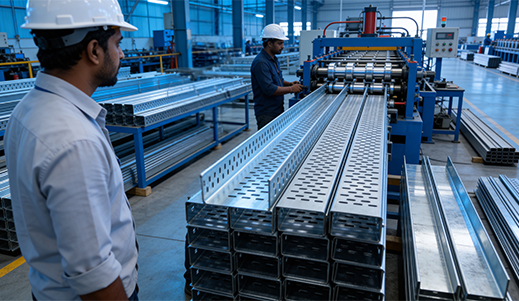
Once production begins, roll forming offers a clear advantage through its continuous and streamlined process. Unlike traditional methods that involve multiple steps, roll forming produces components in a single, uninterrupted flow.
Faster Manufacturing Cycles
Roll forming enables continuous production, allowing components to be manufactured quickly once the setup is complete. This significantly reduces production time and helps projects stay on schedule, especially in large-scale applications.
Consistent Quality Across All Components
Since roll forming is a highly controlled and automated process, it ensures uniformity in every component produced. This consistency reduces variations, improves reliability, and minimizes the chances of defects.
Reduced Dependency on Manual Processes
Automation in roll forming reduces reliance on manual labor for repetitive tasks. This not only improves efficiency but also lowers the risk of human error, ensuring smoother production workflows.
Supporting Smooth Project Execution
During the execution phase, consistency and reliability are critical. Delays or inconsistencies in component supply can disrupt the entire project timeline.
Roll forming ensures that components are produced with uniformity, making installation and integration more efficient.
This leads to:
- Faster on-site progress
- Reduced rework and adjustments
- Improved coordination across teams
Minimizing Material Waste and Cost Overruns
Material management is a major factor in project efficiency. Roll forming is designed to use material effectively, minimizing waste during production.
Lower material wastage contributes directly to cost savings and supports better budget control throughout the project.
In large-scale projects, even small improvements in material efficiency can result in significant financial benefits.
Enabling Scalability for Large Projects
Modern infrastructure projects often require large volumes of identical components. Roll forming is well-suited for such requirements due to its ability to maintain consistency at scale.
As production volume increases, efficiency improves, and the cost per unit decreases. This makes roll forming an ideal choice for projects with high-volume demands.
Reducing Rework and Improving Quality Control
One of the hidden costs in any project is rework. Variations in components can lead to adjustments, delays, and additional expenses.
Roll forming minimizes these risks by delivering consistent and precise output. This improves overall quality control and ensures smoother project execution.
Conclusion
Efficiency in construction is achieved through a combination of planning, execution, and the right manufacturing processes. Roll forming plays a vital role across all stages of a project—from concept and design to production and final implementation—by delivering speed, consistency, and cost control. With its ability to support large-scale requirements while maintaining precision, it has become an essential solution in modern infrastructure projects. With a strong focus on quality, reliability, and timely delivery, Aparna Rollform supports clients in achieving higher project efficiency and better overall outcomes. By integrating the right processes with the right expertise, businesses can reduce delays, optimize costs, and maintain consistent standards throughout the project lifecycle.
Frequently Asked Questions (FAQs)